Mailing List and Giveaway Signup


← Click to join my mailing list and receive a free copy of my short story Crystal Servants, delivered through MyBookCave. Learn about some of the major players in my novel Crystal King and its sequels Crystal Queen and Crystal Empire.

Adrian, a spy for the King, sees a nobleman murder a servant. His desire for truth is pitted against the dangers of a high-stakes political game. When his friend Draken insists on pursuing justice, Adrian must protect those he cares about as the political games of powerful men alter the lives of everyone around him.

Showing posts with label editing. Show all posts

Tuesday, February 21, 2023

The Best of the Planetary Anthology Series

 I've got a new anthology coming out. The Planetary Anthology Series of eleven books has gone out of print, so I contacted the publisher to get their blessing to put together a single book pulling two stories from each volume. This is the result.


The official release date if February 27, 2023. You might notice on the date of this post that this is still almost a week away, but here's a secret. I released it a few days early. :)

This book contains 22 stories, selected as the best available, to go into this remastered, re-edited volume. Here's the lineup:

Sol

  • Sundown And Out (David Hallquist)
  • Let The Dead Bury Their Dead (Caroline Furlong)

Mercury

  • The Mirror of Circe (John C. Wright)
  • The Element of Transformation (L. Jagi Lamplighter)

Venus

  • The Fox’s Fire (Danielle Ackley-McPhail)
  • The Rocket Raising (Frederik Gero Heimbach)

Earth

  • We'll Always Have Earth (Bokerah Brumley)
  • Extinction Point (Richard Paolinelli)

Luna

  • Luna Sea (Jody Lynn Nye)
  • Samaritan (Karl K. Gallagher)

Mars

  • Human, Martian—One, Two, Three (Kevin J. Anderson)
  • The Clockwork King of Mars (C.T. Phipps)

Jupiter

  • Sunward (Jeb Kinnison)
  • Freeze (Jane Lebak)

Saturn

  • The Clockwork Copper and the Priestess of Mystery (J.M. Anjewierden)
  • Doing My Job (Dana Bell)

Uranus

  • Room to Breathe (Marina Fontaine)
  • Muddification (Clint Hale)

Neptune

  • The Dogfisherman (Edward Ahern)
  • The Lost Wind (David Breitenbeck)

Pluto

  • The Heart of Pluto (Christine Chase)
  • A Brush (J.D. Arguelles)


Sunday, November 3, 2019

November Status Update

There's a lot going on this month.


  • I'm writing a novel for NaNoWriMo.
  • I'm prepping for a December 17th release of Crystal Empire.
  • I'm editing another author's novel.
  • I'm spending extra time at the day job in a software crunch.
  • We host 20-35 people for Thanksgiving, depending on the year.
  • The daughter's boyfriend will visit from Chile if he can get a flight out.
Some of that, including some Crystal Empire pre-release art is in my November newsletter that you can find here.

I'm hoping for some time to sleep wedged in there each night. :)

If you sign up for my newsletter through the link at the top of my blog, you get my monthly status updates and my monthly Reading Corner where I highlight a book, often selected from or by the authors I know.

Sunday, August 25, 2019

Quills 2019 Report

The League of Utah Writers just finished its 84th annual conference, renamed as the Quills conference last year. Since I'm the President-Elect of the League, I did a bunch of running around in the background. Luckily, I had a chance to catch a few of the awesome classes.

We had Michael Stackpole and Anne Hillerman visiting and teaching, along with several amazing out-of-state and local editors who took pitches. The majority of the teaching staff of about 35 people was made up of local authors, but that also included some folks who have been in the business for a while. I would name more of the awesome people who came to help out, but it's easier if I direct you to the league website to the Quills 2019 page. (The page may flip over to another conference or vanish eventually, but should be good for a while.)


Aside from all the other winners in the writing contests, it turns out that an anthology I edited, Put Your Shoulder to the Wheel (published by Immortal Works), won a Gold Quill award. I'm officially an award-winning editor!

We're already planning for next year, and we want to pull out the stops for an 85th conference in 2020, but before that we'll have a smaller locals-only one-day conference on April 18th. That one will be my responsibility, but we have a dedicated conference committee that knows what they're doing. They make my job much easier.

Sunday, February 24, 2019

More Anthologies

It's been one right after the other for a while. It's great when things like up like this. For anthologies released in three months!

December 1, 2018 - The Hundred Worlds
December 4, 2018 - All Made of Hinges
February 5, 2019 - Put Your Shoulder to the Wheel
February 14, 2019 - Trace the Stars

Just as a point of reference, I wanted to show my amateur author rank numbers on Amazon to show what can happen with a rapid-fire release schedule. Those who know how the rankings work will not be impressed by the absolute numbers I show, but what I want to point out is that short fiction can have cool side effects. When an author can maintain a ranking, the Amazon algorithms can notice. I hope it is self-sustaining.


Now, author rankings on Amazon don't really mean a lot in terms of dollars in the pocket. It works the other way around. Sell a lot, and your ranking goes up. Rankings are just one indicator that you have a little traction in the marketplace.

I also have a story in a First Contact anthology coming out within the next month or two. It's been a great winter. Now I need to buckle down and finish my trilogy. I'm about 15,000-20,000 words from finished. It won't be out until probably sometime in the fall.

Tuesday, November 27, 2018

New short stories

It's double release week for me, with two new short stories coming out. First (just out today) is the anthology All Made of Hinges which contains my story Marching on to Glory. It's a collection of Mormon Steampunk, and is lots of fun. The idea was to include in each story some element of steampunk and some element of the Church of Jesus Christ of Later-Day Saints. In my case, I took the story of the Mormon Battalion and put them on an airship and armed them with steampunk-inspired repeating recoilless rifles.

I'm the editor for volume two of the Mormon Steampunk anthologies. Put Your Shoulder to the Wheel should be out in January 2019, with the third volume coming out in March 2019.


Second in line, coming out December 1st is The Hundred Worlds anthology, a shared-world where I'm writing in someone else's sandbox. This is a new experience for me, and it involved a lot of back-and-forth with other authors and the editor to make sure all the stories were consistent with each other since all our stories are in the same universe. My story Three Strikes tells of a woman with a lot of patience as she seeks justice for crimes against her family.


Both projects were put together with great editors and co-authors, and I'm happy how they have turned out. All Made of Hinges went to at least #6 on Amazon's Hot New Releases in one of their Steampunk categories today (it's first day).

Friday, February 23, 2018

LTUE 2018 Report

Life, the Universe, and Everything was a great success. For those not in the know, it's a writer symposium held each spring in Provo, Utah. It's growing and has expanded from the Mariott hotel to include some rooms across the street in the Provo Convention Center.

I attended several panel discussions and was a panelist on three this year. I'll go through everything in chronological order.

One bit of sad news is that my new phone doesn't take pictures as well as my old phone did, so you'll have to deal with amateur photos from a bad camera.

Write like you're running out of time


The authors on this panel shared ideas on what being productive means. For some, it's a book or two a year. For others, closer to eight books a year. Everyone needs to find the path that fits them and matches their goals.

So you want a revolution


These folks covered the differences between uprising and revolution and talked about how control of power (including magic in fantasy settings) gives control of the government. Any good revolution needs publicity, a plan, and an idea of what they'll do next. One of the more interesting topics was that of strategic losses. George Washington had a horrible record of many losses and few victories, but all of his losses gained important benefits.

Kaffeeklatsch with Larry Correia

Larry has an endless supply of personal funny stories even without delving into his books. He also took a lot of questions. I asked about what to look for in a publisher's marketing plan for a book release. His response was, "Don't expect much." Unless you're one of the big names, publishers won't put a big push behind a new book, especially from a new author.

Kaffeeklatsch with Sarah Hoyt


Sarah talked about a wide range of things including the process of how some of her books came to be. She also answered questions. We had a great hour hearing about collaborations and success stories.

Andre Norton: Grand Dame of science fiction and fantasy


This panel was a lot of fun to be on. I had a ton of notes, and I'd read "The Jargoon Pard" and another book or two as homework. She had a love of time travel, cats, crystals, ESP and other mental powers, mysterious alien races, and had a strong sense of good guys vs. bad guys.

Writers of the Future gathering


I've got a stack of "Honorable Mention" certificates and one "Semifinalist" from Writers of the Future, so I showed up to a little meet-n-greet set up to honor yet another winner from Utah. There were no real presentations, but Dave Farland talked to us for a bit about the contest and how Utah always seems to have a disproportionate number of people in each category.

Write what you know


Unlike what you might expect with that name for a title, there was a lot of discussion on how to write stuff you might not be an expert at. Of course, L. E. Modesitt has a diverse history with an amazing range of skills, and he's used them in his writing. But nobody here had experience with riding in space ships. Take what you know, extrapolate where you can, find experts to help you, and make up something that sounds good for the rest.

Writers of the Future: Utah's 20th winner


Dave Farland talked along with three past winners about what goes into a winning story. Some of it was reminders of the basics like including try/fail cycles, and making sure you have good character, setting, and conflict in the first two pages (or less). The idea, the story, and the style are each graded when they evaluate submissions.

Jo Walton Keynote


And here's the evidence that either my camera stinks or I don't know how to run it. Sorry.

Jo talked about what an individual can to as a genre writer to improve the field. This included loving what you write. This doesn't necessarily conflict with writing to a particular market or audience.

Writing science fiction tropes

I was on this panel, and forgot to have someone take a picture. I know this may crush your deprived soul, but I think you'll get over it.

We talked about how tropes are not always bad. In fact, tropes are not only useful, but necessary to writing fiction that resonates with the reader. Tropes are a wonderful shorthand to get ideas across quickly. You have to be careful not to use the old cliche tropes in the same old boring ways is all. You can even use the old cliches if you put a new and interesting twist on them.

Pre-writing


Both Melissa McShane and Dave Butler are friends, so this one was a fun panel to attend. I seem to have shown up to several things with Dave Farland, as well.

Prewriting is an interesting topic since some people do without it entirely (called pantsers), while others may obsess over it so much they never get to their writing. Based on your writing style, it can help to have an idea where you're going and have that in writing so you can refer to it.

Writing Steampunk


I remembered to hand off my camera for a picture. It seems other people can take better pictures with it than I can. It might be time to experiment with taking pictures to figure out how it works best. You can see I got out my wooden bowtie with the spinning gears for this panel.

We had some differing opinions on exactly what steampunk was, but for the most part we agreed that it was a very welcoming umbrella which included a lot of ground. The sub-genre of steampunk has only been named fairly recently, but the community and ideas grandfathered in several works by H. G. Wells and others who died before the term was invented because their writing (Twenty Thousand Leagues Under the Sea) fit perfectly.

When the term Steampunk first popped up, some people wanted it to be a dark, gritty afair. The costumers got ahold of it and spun the idea on its ear and made it bright, shiny, and full of hope for a world with Victorian manners and futuristic technology as someone from the 1800's might see it.

Book Signing


We had a book signing Friday night, and I met an online acquaintance, Kal Spriggs, face to face for the first time so I had to get a picture. My wife took the picture, and my camera must like her better than it likes me.


Then there was the incident when I had Sarah Hoyt sign three books for me. She was about to sign the first book when Larry Correia distracted her somehow. The small print here says, "This book has the wrong inscription. It's Larry Correia's fault." Then she made Larry sign it as if it were a written confession.

Powered Armor: Design and tactics


Yes, me taking another fuzzy picture. I must figure this out.

I attended this one specifically because I'd just had one of my short stories, "Unacceptable Losses," accepted for an anthology. It has powered armor as a major part of the story. It turns out that most of what I did matched up with what these guys (three military guys and a scientist) had to say about how powered armor would likely work and what you would need to watch out for. That made me happy. One thing I may have forgotten to address is the problem of managing heat, particularly from weapons.

Short Stories in a nutshell


How do you cause an emotional response in your reader with something as small as a short story? There are some tricks you can pull such as putting children in peril, but you can't do the same thing every time. you have to build investment in a character quickly. One way is to show the character holding back their emotions (just barely) so the reader is free to bust loose for them.

You need to get quickly to where interesting characters are doing interesting things. One trick I heard is that editors may skip to the end of even a story that starts really well just to see if it's been botched at the end. Eric James Stone said those good stories with the bad endings are the worst because the editor has now wasted the time to read the whole thing before rejecting it.

Todd McCaffrey keynote

Oops, forgot a picture again. Todd talked about a lot of things, including writing with his mother. He told some fun stories about how they'd agreed to collaborate on something, and to do so, she would kill a dragon to set up a storyline he was working on. She called him in tears. "I can't kill the dragon!" Sometimes you have to work things out in a different way.

He talked a little about old Chinese curses, only two of which I was familiar with.
  • May you live in interesting times.
  • May you be noticed by people in high places.
  • May you get what you wish for.
  • May ALL your dreams come true.

Trace the Stars benefit anthology


I went to a little open house for this benefit anthology designed to help finance the LTUE symposium. I've submitted a story to it, and I've made it past one editor. I have my fingers crossed. This would be a nice one to get into even though it won't pay the authors. It's good to give back to LTUE, which is one reason I like to help on panels. It would also be really cool to be in a book with the authors already on board.

Writing Children

Huh. Another missing picture. I must have been distracted.

This is writing characters who are children, not children who write. It can be annoying to have little kids who behave like undersized adults, but it can also fail miserably if you make the character too realistic since most children wouldn't deal with situations writers put their characters into. They need to be believable even if they're extraordinary in some way.

The concept also varies based on who your audience is. If you write for kids, you may write differently than if you're writing for adults and have kids as side characters.

Writing Battle Scenes

Hey, that picture wasn't half bad. Maybe I'm getting the hang of it.

I've addended several panels on action scenes in the past, but this was geared specifically to battles. I wanted to beef up my knowledge base since the next book I'm writing (Crystal Prince) is going to include a war with six kingdoms. That's a lot of complexity.

Skirmishes are more hit and run while battles are more organized and planned out (at least until it starts).

Pacing can vary from the overall panoramic view a commander might see all the way down to the sheer panic felt by someone on the front line.

Two suggestions I picked up are to avoid the blow-by-blow of an entire battle since that would take forever. Also, avoid descriptions that are all I... I... He... He... since that comes off as checklisting the fight to make sure you've got all the actions in the right place. It's better to hit a couple of details, then zoom out and shortcut the fighting.

For dialog, remember that dangerous jobs often lead to odd humor and coping skills.

Summary

So, there you have it. Another LTUE is in the books. My next appearance (aside from teaching calligraphy at Wizarding Days tomorrow) will be the League of Utah Writers spring conference.

Sunday, December 31, 2017

2017 Wrap-up and Writing Goals

Holidays Winding Down

We had a wonderful Christmas with lots of time spent with family. My wife's birthday party Christmas Eve consisted of making custom tree ornaments. She rolled her eyes at me when I helped one of my sons stuff a clear glass ornament with cat hair and glitter. We had kids, their in-laws, and others over Christmas morning. We visited a local park with a tree lit up as the Tree of Life. I didn't get down to see the lights at Temple Square in downtown Salt Lake City this year, but most of the family was there at one point or another.

I hope your holidays were as joyful and filled with family as mine.

Goal Report

Last December I posted some goals, so let's see how things went.
  • Finish and publish “Crystal Queen” with Immortal Works.
    • No, but not by far. Crystal King saw some delays, and I've just now got Crystal Queen to where I can send it to the publisher.
  • Speak at three conferences (panelist, presenter or moderator). Most likely are LUW spring and fall conferences, LTUE, Salt Lake Comic Con, and FanX. I’m likely to attend all five either way.
    • Yes. I presented at LUW spring and fall, LTUE, and Fyrecon. It was a lot of fun. I'll be at LTUE again in February as a panelist and I'm proposing panels for LUW and Fyrecon for next year.
  • $200 in face-to-face book sales at conventions and conferences.
    • Maybe. I haven't crunched the numbers, so I don't know for sure. We had a very successful booth at Salt Lake Comic Con, with some success at LUW, LTUE, and Winterfaire.
  • Publish four short stories. (stepping things up from the 3 and 2).
    • Yes. I sold six. It's a difference in semantics when you talk about sold vs. published. Sold is easier to track. I'm also tempted to bend the rules a little since one of the six was poetry rather than a short story. Also, coming in as a semi-finalist at the Writers of the Future is a rejection, but it's a highly valued rejection.
  • Get 30 short story rejections.
    • Yes. I got 35. I measure rejections because it's a way to turn something that's usually a negative into a scoring mechanism. If I keep my stories out there gathering rejections, I will also gather sales. It worked. I got only a few more rejections this year compared to last but I doubled my acceptances.

Crystal King Published

The book came out in September through Immortal Works and you can buy it here. When I sign this book I usually write "It's all about family and friends." This applies to the story, but it also applies to life in general. Families are the bedrock and foundation of society.

It was a long road to publication, about two years in the making. As a first fantasy novel it required a bit more editing and adjusting than my second effort which is already prepped and almost on its way to the publisher.

Short Stories Sold in 2017

I didn't enter the Utah Horror Writers contest for their anthology this year since I was too busy with other projects. Some of the stories from this year are online or for sale in ebook or paper format. Others are not quite in print yet. Here is a list, including one long lead-time story sold over a year ago and still not quite out.

Learning to Run with Scissors (sold 2015, due out in an anthology next year)

Dissonance (due out online next year)
Market Rat (free online at Silver Blade)
Protector of Newington (Storyhack Issue 1 on Amazon)
Unlocked (poetry in a League of Utah Writers Antho on Amazon)
The Bannik and the Soap (due out in an anthology next year)
The Lure of Riches (Clarion Call 3 on Amazon)

2018 Goals

Here's what I want to accomplish this coming year. I'm not going to keep up on the short story rejection list because I'm transitioning more to targeted anthologies along with the novels. The shorts have done well for me in the past, so I will continue some effort there, but maybe not quite as much as in the past.
  • Send Crystal Queen with my publisher (nearly there!)
  • Write Crystal Prince and submit it to the publisher.
  • Get another Semi-finalist at Writers of the Future. I've got a small stack of honorable mentions now.
  • Write a science fiction series outline. Depending on the timeframe for Crystal Prince, I may be able to do this as a NaNoWriMo project in November.
And there you have it. 2017 was a good year. I expect 2018 to be even better.

Wednesday, October 11, 2017

The Hurrier I Go, the Behinder I Get

I'm coming down from a hectic month, and things going forward look about as congested as what I see in the rear-view mirror.

The done list:

  • I finished my first draft of Crystal Queen.
  • Salt Lake Comic Con - We had a vendor booth and sold a bunch of books. I had some early copies of Crystal King and nearly sold out. I did a lot of networking and attended a couple of presentations.
  • Snake River Comic Con - I presented on virtual reality and augmented reality. It's part of what I do for the day job. I met some new folks and had lots of fun.
  • League of Utah Writers Fall Conference - I did some volunteer work, team-taught a Virtual Reality class aimed more at authors, and sold some of my newly re-acquired stockpile of early copies of Crystal King.
  • I did a proofread pass on a friend's book and fired off a list of changes last night.
The to-do list:
  • I may join a podcast this week to prep for my book release.
  • I was invited to contribute a short story to an anthology, due this month.
  • I want to write and send something to an open submission to another anthology due by year-end.
  • I want to send something to Writers of the Future before year end to see if my semifinalist placing can be repeated or beat.
  • Finish my first edit pass for Crystal Queen, then start another pass with specific goals in mind, such as fleshing out scenes or adjusting voice.
  • Prep for NaNoWriMo. I want to get a draft of Crystal Prince done in November, then I can look at the two drafts side-by-side.
  • Move my short story Crystal Prince to be a freebie available on Amazon. This will take some formatting work, but shouldn't be too tough. I've done it before, and it's almost done as-is with the copy on InstaFreebie.
  • Find a venue for my Crystal King release party. Yes, I've let this fall between the cracks and get lost for too long.
So, why did I give you the play by play? It's not to convince you I'm busy so much as it is to convince you that it's possible for you to make effective use of your time, and for you to schedule, work toward, and achieve your own goals.

I've told the kids at our house that I wish I had time to be bored. I would still not be bored, I just wish I had the time. They were not amused when I had dozens of assignments to hand out to cure boredom. It's like my view on sports cars. I'd love to have the cash for a Maserati. I'd go invest it sensibly instead of buying the car. Your mileage may vary.

No matter what it is you like to do, it's up to you to make it happen. I like to make things. If I don't schedule the time and put in the effort, I make nothing and I have nothing to show for how I've spent my time. Having plans to build a desk or write a book is a good start, but it's nothing more than that. You can't sit at a desk that hasn't been built yet (aside from using VR) and you can't read a book that hasn't been written yet.

If you want to create something, do it. Ideas are only useful when you do something with them. I have faith in you.

Saturday, May 13, 2017

Evolution of an Ebook Cover

I have a short story now available for free as a promo for my novel Crystal King. The problem is that I needed a cover for the ebook, and didn't want to spend a lot for something that's a freebie, and didn't want to do it without a cover.

Now, you must realize something. I'm a software engineer by trade. I do programmer art. For those not familiar with the term, it's what you get when the engineer drops placeholders into the project to be replaced by the art director later. Stick figures, colored boxes and the like.

I decided it was time to branch out my skill set a bit. I dug up this photo from a vacation last year where my wife and I visited Mount Saint Michael on the Normandy Coast.


It looked medieval (being a castle and all), so I figure it would make a good base. Next, I needed a couple of characters. It's a night scene, so all I needed was silhouettes. To oldest son: "Hey, you. Can you come here for a minute? Wear this. Now hold your hands like so. Good. Now, look like someone's interrupting your sneaking. Cool. Thanks."


Next, came The Gimp. It does most of what I want for image editing, and it's free. I loaded everything up and made the silhouettes. I added some weapons to emphasize the fantasy theme. The level of detail here is not critical because of what I do later, but I kept the detail pretty high anyway. It was easy to add weapons and boots.


I'm making an ebook cover rather than print, so I set everything to 72 DPI. It took a bit of work to colorize the background to turn it into a night scene. Here's the final background with the silhouettes in place.


This looks a little goofy, so it's time for some artistic magic. I used FotoSketcher (also free) to turn it into this next image, which has an oil-painted feel to it. This is the result of several passes through the trial and error loop as I updated the base image, the silhouettes, and the FotoSketcher settings.


I combined my intermediate cover art with text, and both evolved over several passes. These are the covers I built, with the last one using a lightened version of the previous picture.

Me: How about this?


Smart people: Nah, fonts don't work well. Can't tell it's fantasy from the picture.

Me: Okay, try this one.


Smart people: Hmm. Nope. Fonts are better, but wording needs help.

Me: I'll try something new with the text and lighten it up a bit. It prints darker, but since it's an ebook, I don't care how it prints.


Ah. There we go. We're making progress. It's not perfect, but it's far enough up the curve that it will hold its own in comparisons. Now, let's read up on cover design and see what the experts say ... Crud. Reworking some more.


It's interesting how dangerous a little knowledge can be, isn't it? I have a new hammer, and everything looks like a nail. :)

Thursday, April 6, 2017

Search and Replace: John's Pet Peeves Number 8

It's been a while since I've written a pet peeve. This one is aimed at the guy in the mirror because it's my own writing that sometimes annoys me. Over time I've discovered a list of things I can search for after a draft is complete. The more I write, the less I have to rely on this list, but it still saves me and my editors a lot of time by finding problems early.

Also, I keep seeing social media posts on self-editing and words to avoid while writing. I'm going to share my current Search and Replace (or Search and Destroy) list and just point people here as needed. Some of these came from lists, but many are things I've discovered in my own writing.

The Search part is mandatory. The Destroy part is optional since every one of these may be not only valid but the best choice in some circumstance.

I've used these to fix hundreds of instances of passive voice in a manuscript in one evening before. That's a huge time savings on hunting down and fixing things one at a time as you read through a manuscript.

Here's a post at the Writer's Circle of the sort of thing I've kept an eye out for so I can add to my list.

Adverbs

Adverbs can often be replaced with stronger phrasing. The easiest way is to look for the most common adverb ending followed by a space. The space is important since you don't want words with "ly" in the middle. This will be a long slog of a search so you may want to delay it until after you've done the easier ones.
  • "ly "

Bad Starts

The following entries are usually a bad way to start a sentence. Turn on the flag to match capitalization in the advanced search settings for these. These starts set might work well for folk tales or other special cases so your mileage may vary.
  • There is
  • There was
  • There are
  • There were

Weak Words

Weak or overused words to remove or replace in most cases.
  • just
  • very
  • really
  • suddenly
  • amazing
  • awesome
  • that
  • already
  • look
  • there
  • over
  • try
  • so

Passive Voice

Passive voice flags, which could also indicate weak words as shown above.
  • started/starting/starts
  • begin/began/begins
  • were
  • is
  • are
  • have been
  • had been
  • would be
  • would have
  • to be
  • could still

Senses and Emotion

Sensory or emotional crutches can be replaced with showing a scene instead of shortcutting it by telling us the emotions and senses involved. Show the scene that generates the input or thought.
  • felt
  • realized
  • saw
  • heard
  • smelled
  • seemed
  • decided

More Passive Voice

Passive voice with wildcards is a great timesaver in Word. Open the advanced search dialog and turn on wildcards. Then you can search for these passive voice hunters. Again, they're not all bad. Just mostly bad. The idea is to replace things like "was jumping" with "jumped."
  • [Ww]as [A-z]@ed
  • [Ww]as [A-z]@ing
  • [Hh]ad [A-z]@ed
  • [Hh]ave [A-z]@ed
  • [Bb]een [A-z]@ing

Obscure Stuff

Past perfect tense. This is a bit obscure, but it introduces hesitation.
  • had always

Checking Dialog Tags

You can also find lots of dialog tags that could be bad, confusing, or in need of clarification with these wildcards. It finds lots of false positives, so it's not always useful. You can find stuff like "He barked" with this. The last one finds errors where you should have used a comma at the end of a quote.
  • [Hh]e [A-z]@ed
  • [Ss]he [A-z]@ed
  • .\” [A-Za-z]@ said

Layout

Simple search and replace can fix lots of things. Word uses ^p as a paragraph marker when not in wildcard mode. You can get rid of spaces at the start and end of paragraphs with two simple searches, and then nuke all accidental double spaces. You're not one of those types who LIKES double spaces after a period, are you? ;)
  • Replace " ^p" with "^p"
  • Replace "^p " with "^p"
  • Replace two spaces with one.

And there you have it. That's the current state of my Search and Destroy list. Have fun!

Wednesday, October 19, 2016

Homophones: John's Pet Peeves Number 7

I haven't done a Pet Peeves post in nearly a year. Have I been on a path of inner Zen, full of peaceful meditation? No, I've been just as annoyed at things, but haven't shared my annoyance. You're welcome. But thanks to this facebook post, I have a topic. In case that link doesn't work for you, it started out with a complaint about people using grizzly when they mean grisly, and people chimed in with their favorite homophone errors. (Words that sound alike, but with different meanings and spellings.)

One of the biggest problems is that these beasties hide from spell checkers. You need a tool that's context-sensitive to find them. Take for instance my parenthetical statement above. I accidentally wrote "a like" instead of "alike" before I fixed it. Some tools will catch that. Others won't. That leaves us needing to know the difference on our own if we want to write clearly and correctly. Never trust your tools blindly, because they can be wrong. I once sent out a resume with the word "internet" replaced with "interment." The spell checker thought it looked just fine. The funny part is that I got that job anyway.

Writing English can be a big challenge for some, and these beasties are one of the big reasons why it can be hard to write the right word.

So in the interest of enlightenment (and giving me a chance to vent about a pet peeve), I've gathered a few homophone errors for your perusal.

Not a word: (I'll avoid most non-words since spell checkers will find these for you. The first one really bugs me a lot.)

  • "alot": Not a word. "a lot": Many things, or a grouping of things, or an area. "allot": To distribute or assign. You wouldn't write "alittle", so don't write "alot". You can allot a lot of little lots lots of times.
  • “Walla”: Unless you’re talking about half the name of a town in Washington State, you probably mean the French word “voila.” It’s a synonym of “lookie what I just did.”
Wrong word: (in random-ish order)
  • "too": Also. "to": Opposite of from. "two": twice as many as one. "tu": You, in Latin. By odd coincidence, our score was two to two, too.
  • "grisly": Gory. "grizzly": a kind of bear. I included this one because it was what started the whole discussion on facebook. That headless fish is a grisly  prize in the grizzly's maw.
  • "awhile": An adverb. "a while": A noun phrase. If it doesn't work replacing it with "for a short time", then use "a while." In a while, stand there awhile. Sometimes they're interchangeable, but it may change what the sentence means in subtle ways.
  • "aloud": The process of not being done quietly. "a loud": An adjective describing the state of something. A loudspeaker reproduced a noise that a loud speaker at the microphone didn't intend to make aloud.
  • "board": A piece of wood. Usually. "bored": Nothing to do. I'm so bored I'll board this door up. Yeah, I cheated and verbed the noun because it's allowed in this case.
  • "brake": Something used to stop movement. "break": to come apart, or a time to rest. If the brakes fail during your break, the car will roll away and break that wall.
  • "led": To be taken somewhere. "lead": Present tense of "led," or to be in charge, or a metal on the periodic table, or the first of something, or a clue. He led me to the lead paint as the lead item on his list of leads.
  • "lose": To not win, or to misplace. "loose": not held in place. Don't lose loose buttons.
  • "than": A comparison. "then": used to order in time. He was taller than her, then he grew.
  • "write": To put words on paper. "right": To be correct. "rite": A ceremony. Write the right rite. (Put the correct ceremony on paper.) -or- Write the rite right. (Put the ceremony on paper without errors.)
  • "baited": To have bait on it. "bated": stopped or reduced. I waited with bated breath as he baited the hook with a worm. Baited breath makes me think of eating worms.
  • "peek": To look surreptitiously. "peak": a high point. "pique": To irritate, or stimulate curiosity. I peeked at the peak of his head to pique his interest.
  • "stationary": Not moving. "stationery": Writing paper. The stationery was stationary until I moved it, but it was still stationery as it moved.
  • "there": A place. "their": Denotes ownership. "they're": a contraction of "they are." Their friends are over there where they're arguing over homophones.
  • "stanch": Stop the flow of blood from a wound. :"staunch": Loyal or committed. The staunch fistfighter stanched the flow of blood from his nose.
  • "mantle": Something that covers our surrounds, as in a physical cloak or a concept of authority. "mantel": A shelf above the fireplace. The adventurer hung his mantle on the mantel to dry by the fire.
  • "very": extremely so. "vary": to change over time. His temprament can vary very much from minute to minute.

Not Really Homophones: (just some other things that really throw some people)

  • "lay" vs. "lie" vs. "laid" vs. "lain": Um, right. I'll just point you here. People have written entire articles on this.
  • "rifle": A long gun, or to ransack with intent to steal. "riffle": to flip through or thumb through quickly. (Note they sound different, so they're not homophones.) He riffled through the pages of the owner's manual as he rifled the rifle vault.

One fun thing about homophones is that they can work merry mischief when a book goes to audio. Something that's perfectly clear in print may be a jumbled mass of identically sounding words, as you can see by some of my contrived and convoluted examples. Be extra careful out there if you think your writing might ever be read aloud. Expert hint: Read your writing aloud.

I found some of my favorites on other lists like this and this. There are more tickling the back of my mind, so I add others when they rear their ugly heads.

Edit: I rewrote this blog as a guest post for LDS Beta Readers. You can find it here.

Sunday, July 17, 2016

League of Utah Writers Editing Workshop

I attended an editing workshop sponsored by the League of Utah Writers a week ago, and got some good advice from a roster of speakers that spanned several publishers and professional editors.

Our organizers and discussion leaders, Callie Stoker and Johnny Worthen

Callie is an editor, and runs The Manuscript Doctor as a freelance editor.

Johnny is a local author with several books to his name, and is always easy to spot in a crowd.

Our panel of experts
From left to right:
Emma Hoggan—editor at Future House Publishing
Angela Eschler—editor and founder of Eschler Editing
Annette Lyon— editor and award winning author
Lisa Mangum—author and editor at Shadow Mountain

I took lots of notes and had a great time. I got to sit next to my friend George, who has won an award as Utah's Biggest Liar five times. He's decided to branch out from verbal to written word.

They sent out an email with all the slide presentations, but, alas, that's for those who paid to attend. That's your incentive to sign up for the next workshop. :)

The advice on editing ranged from the lowest level of spelling and punctuation to the highest of flow and form. For any who think it's not that hard, give it a try and join the League. If you're right, you're a natural. if you're wrong, you're in the right place to learn what it takes.

Emma is at Future House Publishing, which is doing a wonderful job with their marketing, and involving their authors. I have friends publishing through them and have heard nothing but good about them. Her presentation on Point of View was great. It's something every editor needs to know inside and out, even if you're just editing your own work.

I don't know Angela well, but enjoyed her presentation on narrative structure. She went over scene and sequel structure, as well as how and when to use scene and chapter breaks.

We had Annette speak to our LUW chapter in Herriman a few weeks back as well. She's got quite a range of experience, and covered the nitty-gritty details of punctuation in this workshop.

Lisa covered voice. If you can't tell which character is speaking without dialog tags, you may have a problem.

This workshop was a great way to spend a Saturday afternoon. There's a workshop on Querying next month which should be just as good.

Monday, April 11, 2016

League of Utah Writers Spring Workshop 2016

The League of Utah Writers held their spring workshop on Saturday, April 9th, 2016. It was a great event, with a lot of mid-level to advanced panels on writing, the business of writing, and related classes and panels. Here's what the schedule looked like.

I attended five different panels, all useful. I attended a board meeting before as president of the new Herriman, Utah chapter, but that was all administrative stuff, so I won't torture you with that. On to the sessions!

Marketing Book Checklist
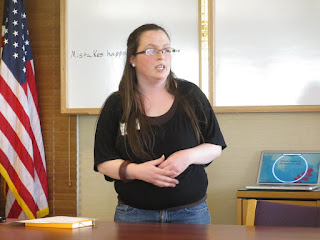
Britney Johnson
Britney spoke about checklists, and how to use them to simplify and organize yourself. For instance, when you are arranging for a book cover, you should remember to also arrange all the associated artwork like bookmarks, facebook and twitter banners, facebook and twitter post pictures (which are a different size than the banners), and all the related things that may have your cover art.

From the marketing standpoint, she talked about ROI (Return on Investment) and how you need to start with a goal, and you need to track the time and money spent, the resources used, contacts made, and books sold based on those expenses.

She also talked about how to pattern marketing after successful authors. Know who follows them on social media. Track their amazon rankings. Scan their social media for their marketing campaigns. All of this lets you map their successful strategies to the spikes of their rankings so you can see what worked for them.

As a rule of thumb, most authors should expect to put 10% of their income back into marketing in one form or another.

In summary, don't reinvent the wheel.

Elements of a Swoon-Worthy Romance

Jennifer Moore
Jennifer spoke on romance. I don't write romance novels, but you can find elements of romance in every type of story, and it can lend a great depth to what you write. Besides, I have friends who have told me I need help here. Being the severely left-brained type, I deduced that they know what they're talking about, and took their advice. :)

While this is not an exhaustive list, these are the elements she talked about. She took them from a longer presentation she's given in the past.

Emotion

I learned a raft of new terms. A Meet Cute is the two characters' first moment  together, with a tug of either attraction or annoyance. They have their Dark Moment, and as you keep their yearning and tension high, you lead to the inevitability of their relationship. Then there's the payoff.

Knowing the language is a big deal. Knowing what people expect from a romance is a big deal, too, even if it's not the focus of a story.

Conflict

Some of this I already knew. There are internal and external conflicts, detailing what the characters must overcome. Internal conflict is things like insecurities, prejudices, class war, and conflicting goals. External conflict is from the environment or other people, and their purpose is to force the characters to face their fears and to expose their internal conflicts.

Internal conflicts are resolved through either character change/growth, or the character exposing their true self.

Sacrifice

The characters must each give up something. If she meets "the wrong guy" first, then he may refuse to sacrifice for her, demonstrating to the reader that it was never meant to be. Whoever is the most flawed gives up the most and makes the Grand Gesture (another dictionary entry for me) to grow the most.

Dialog

Dialog is good for increasing "show" and reducing "tell" but must be done right, in a way that feels natural. This reminds me of a panel at LTUE dedicated to dialog where they talked about the difference between "natural" which is boring, and "feels natural" which can be very useful.

Dialog puts us in the scene and is a powerful tool. We can understand when a character says one thing and means another if it's done well.

Character

This was listed as the biggest factor in the list. When we remember a book it is because of the characters, their flaws, and the way the plot turns based on their flawed choices.

Jennifer noted that it may not seem fair, but in a typical romance, the male character is the most important, and must be lovable.

Identity vs. Essence is critical. An identity is what someone appears to be, or how they portray themselves, or what they first see in someone as the superficial surface. Essence is what they truly are. The right person falls for the essence, while the wrong may fall for the identity. Gaston falls for Belle's pretty face while the Beast falls for her good nature.

Alpha heroes are typically strong, macho, powerful and successful, but also tender.

Beta heroes are softer, playful, charming, considerate, and must fall on the right side of the line between nice and wimp.

The heroine must be a symbol to the reader to generate sympathy, envy, or kinship to draw the reader in.

Self Publishing

Ruth J. Craddock

Ruth has a great collection of quotes. I didn't get them all down, unfortunately. One I got was "If you never give up, you can't fail."

The stigma of being self-published is diminishing quite a bit, and times are changing. She decided to go with the self-pub route because when she finally got a publisher to give her a deal, it was a mess. She turned it down after learning of the nightmares of other writers, and figured she could do it herself.

The good thing with self-publishing, is you have full control of everything. The bad thing is that you have full control of everything. The tricky part is to do it with quality.

You will get what you pay for. Be ready to pay for editing, art, marketing, layout, and whatever else you are not an expert at.

For editing, check with multiple editors to get someone who matches your style, and is interested. Then get a sample edit to make sure of the match. Most will do a sample chapter.

She was kind enough to sign a couple of books for me during the break between sessions.

Anatomy of a Social Media Campaign

Mike Bacera
Mike gave a crash course on what a social media campaign looks like. Success of many campaigns is measured in dollars.

He dispelled two rumors up front. First, that you can sell to your followers, and second that you can't measure success. A bad post will do nothing more than annoy followers, while a good one isn't likely to turn them into an advocate. You don't go to twitter thinking, "I want to buy a book today. Let's see what people are tweeting about."

Social media is the spice, not the meal. The point is to enhance, not to be the end result.

In general terms, a campaign is an effort to meet a business goal. It's normal to expect 80% of the results to come from 20% of the work. It's hard to predict what that 20% is, so you have to do the other 80% anyway.

A campaign strategy is the guideline, while the campaign tactics are the specific actions to take.

The highlights of a plan come in phases.

Research

This includes analytics and Return on Investment, identifying other campaigns to see what worked.

Plan

You need goals, desired outcomes, indicators, activities, and output as part of a plan. An example of a plan my include events planned four weeks out, two weeks out , one week out, the day before, day of, afternoon of, the evening of the event, and the day after to keep awareness up.

Experiments can be used to test for what succeeds the most. If you have a good mailing list, do an alpha/beta test by sending out two or more different emails to a small subset, then send the one with the best results to the rest of the list.

Design

Bad designs are all different. Good designs share a lot of common attributes. At about this point, we ran out of time, so Mike gave us an opportunity to sign up for his mailing list to get a copy of the full presentation. Do you see what he did there?

Mike gave me some additional information to add so we're complete on Design, Share and Measure. Thanks, Mike! I've added it here:

Design continued...

Create good content. Don't steal other people's content (emulating other people's content is great though)

Share

Learn how to effectively share your content on multiple platforms. Balance "being everywhere" with "being where your audience is"

Also, "Social Currency"
Whenever you post something funny or useful, you GAIN social currency
Whenever you ask people to take action (by my book, like my page) you SPEND social currency
Whenever you post something hateful or obnoxious, you LOSE social currency

When a person decides that your social currency has gone to zero or is negative they will block, unfollow, mute, or otherwise stop listening to you (this is bad)

Measure

If you planned your campaign right, you should have metrics. This will come in 3 forms:

Analytics: every major social media platform has it's own analytics (FB analytics, twitter analytics, mail chimp analytics, etc)

Trackers: services like bit.ly and google analytics will let you track anything else that doesn't have it's own analytics page, letting you know click through rates and many more

Surveys: After a major campaign, survey your people.

- And then back to the 80-20 rule, which I think is the most important part. After the measure step, research your past campaigns and find out which performs best. That is is your 20%, keep doing that. The ones that failed (80%) either a) fix them, or b) stop doing them.

So yes, you will have to do some 80% activities in the beginning, but over time you will keep repeating and tweeting the 20% of activities that generate the most likes, shares, favorites, reviews, newsletter signups, and yes, sometimes, money.

Always think about ROI, which is

Desired Metric / Investment of resource.

For example, on Saturday I got 25 newsletter sign ups for a presentation that took 7 hours to prepare and 1 hour to give. So my ROI is

25 signups / 8 hours = aprox. 2.125 signups per hour.

If I can do something that generates more sign ups per hour, I am increasing my ROI, which is good. (this is only an example) :)

Writing and Editing Short Stories

Paul Genesse
Paul spoke about editing short stories, and that everyone should write them, even if they think they're only a novelist. Short stories build skills and allow for greater experimentation. There are lots more advantages, such as being small enough to finish a lot easier than a novel.

He gave a lot of advice about starting fast, and rocking the characters world, and keeping tension up throughout. You have to make the reader care. It's all about emotion. It would be a good idea to peruse the library, and read a lot of first lines to get a feel for what works, and why.

Everything in a story (not just shorts) must move the plot forward. The main character should be making choices. Passive main characters are boring.

Other little bits of advice are to limit the number of characters, generally to two or three. Also, voice matters. First-person works well, but third-person limited works well too. Third person omniscient, and second person, not so much. Shorts must end with a twist. Also, use the five main senses on page one.

Friends
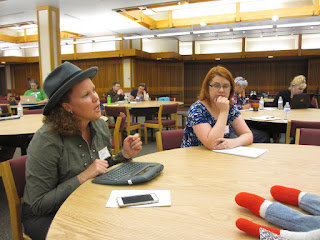
Jodi Milner and Melissa Proffitt and my sock monkey in the corner
Jay Barnson
Several of my friends were also there. Here are pics of a few, but I kept forgetting to get the camera out while talking to people. It was fun to hang out, but we also purposely split up on some sessions to cover more ground so we could share notes later. While there were the occasional hiccups or challenges, it was a good time and I am glad I was there.

Sunday, March 27, 2016

Salt Lake Comic Con Fan Xperience (FanX)

I attended several panels at FanX this year. In general, the writing panels were targeted more toward beginners than at LTUE. Even so, there was a lot of fun to be had and things to be learned. Somehow I managed to miss getting pictures of a couple of the panels, but most of them are shown below with a summary of my notes.


In addition to the panels, several authors published through Xchyler Publishing along with me got together to staff a booth to sell books. It was a great experience, and it was nice to have a full-sized booth. We were sponsored by my wife Kelly Olsen, a Realtor. Go and give her Facebook page a like, and remember her when you need a geek-friendly realtor to help you buy or sell a house in or near Salt Lake County. :)

Now on to the panels!

Thursday

Pantsing or Plotting: Discovery Writing and Outlining

Shannen Camp, Angela Corbett,Julie Frost,Jennifer Jenkins,David J. West,Dan Willis

The panelists talked about several different plotting methods such as Save the Cat, Seven Point Story Structure, Three Act Structure, Hero's Journey, Thirty Point Beat Structure (attributed to Stephenie Meyer), Snowflake Method, and so on. One reason there are so many is that people's writing styles differ, and what works for one person may not work so well for another.

Our panelists were all to some degree a hybrid between pants and plotter, with some having tried seat-of-the-pants writing without plotting, and decided it was too much work. The problem is that writing without an outline means you will spend a lot more time in editing as you fix the technical details.

A better approach is to use that seat-of-the-pants creativity to fill in the details between the main points. Some other fun hints are to write your back cover blurb before you write the book.

Building the Scene: Step-by-Step Instructions for Fantastic Fiction

Sean A. Hoade

Sean's web site has lots of videos and stuff from his past presentations.

Scenes are what make fiction dramatic. Short fiction can bend things a little more due to its sometimes experimental nature, but novels really need scene styructure because scenes use a pattern to impose order on what happens in the story.

He covered some of the basics, such as what goes into a scene.

  • Character Goal
  • Opposition to the Goal (a person or nature)
  • Conflict
  • Resolution

The thing about resolution is that it can take several forms, some more interesting than others. It's important to know when to use each.

  • No. The character failed.
  • Yes. The character succeeded. Generally boring and should be avoided.
  • Yes, but... The character succeeded, but has a new problem surface.
  • No, plus... The character failed, and other bad stuff has been piled on.


Friday

I've Written a Book, How Do I Get It Published?

Dave Butler, Richard Paul Evans, Heather Rubert, David J. West, E.B. Wheeler, Michelle Witte

The panel had a mix of self-published, publisher-published, and a couple of acquisition editors. The panelists were asked what they would have done differently if they were staring over now. Two responses were to self publish anything not aimed at a publisher a lot sooner, and to get involved in the social side earlier with critiques, alpha and beta readers, and so on.

Self-publishing taught one of the panelists that writing is running a business, not applying for a job. If you think your job is to write and toss it over the fence for a publisher to do the rest, you're wrong. More publishers, particularly smaller publishers, are getting their authors involved in marketing, building a platform, maintaining contact with a readership, and taking more responsibility for their own success. This makes self-publishing and going through a publisher a lot more similar than in the past.

If you have a niche book, you might be able to find a matching niche publisher. There are a lot of small publishers out there, and many of them know exactly who their narrowly defined audience is. Different books and different publishers have different goals.

Character, Setting, Plot: Making Your Writing Do More

Frank Cole, Peggy Eddleman, Claudia Gray, Mikki Kells, J. Scott Savage, James R. Tuck

Everything you write should either illuminate a character or advance a plot. If you aren't doing one of those two things, you should either change or get rid of it. (Of course no rule is absolute, but this is a pretty bad one to ignore unless you have a good reason.)

Some interesting tricks to improve the power of your writing are to work to see scenes through the eyes of the character. A scene will be seen differently based on the character and what will seem important to them. Another idea is to figure out what lie a character may believe. This gives you a chance later to have a big reveal later to put the character through a transformation.

Four-Part Pacing: A Guide to Better Storytelling

J. Scott Savage

Scott offered to send his slides for this presentation to those who asked. I haven't contacted him yet, but his web site should work to ping him. He talked about dividing stories into four different parts. Each was labelled as "the most important part." :)


  1. Setup, sub-conflict, planting seeds, and introducing characters. The sub-conflict is resolved at the end of the first quarter as the main quest kicks in. Clues are given, and there is foreshadowing.
  2. Start the quest. This is often a false path where seeds are sewn to reveal the true quest at the end of the second quarter.
  3. The true quest is revealed. Major obstacles appear. The main characters have internal and external dilemmas which collide. Tension increases, and beliefs are questioned. The characters may discover something they have always believed is wrong.
  4. A major revelation. You don't want the reader to put the book down in the last quarter. Main character has a plan, and the plan fails. It's extra cool if you can get the reader to guess that plan before it is used. Don't cheat the reader, and deliver what was promised. In the end you have lessons learned and personal change.

Future of Biotechnology

Charlie Pulsipher, Blake Smith, John Steiner, Eric James Stone, Eric Swedin, Cassidy Ward

I missed the first few minutes of this one because of way too many people to talk to on the way. I ended up not taking a lot of notes, but this was an interesting panel to bounce back and forth between some very science-literate writers who have a lot of technical expertise to draw upon.

To apply this to writing, you're not going to be an expert at everything. When you need to do something new, you can get the details right by drawing upon an expert. Nanotech, biotech, anatomy, physics, whatever it is, someone will know their way around your topic and can steer you away from things that will seriously annoy people when you get it wrong.

Things I Wish I'd Known Starting as a Writer

Kevin J. Anderson, Rebecca Moesta

Kevin and Rebecca gave a list of points to consider. Normally this is a 2+ hour presentation, so they had to rush it a bit and trim some of their stories out.

  • Act like a professional. Never be a jerk.
  • Talk, act and dress professionally. Branding is a big deal. Unfortunately, he's had to deal with those who need reminders on basic hygiene like brushing teeth, bathing, and combing hair.
  • If invited to participate in a writing project, be on time, be the right size, and on the right subject.
  • Don't whine. If you've signed a contract, it's too late to complain about its content.
  • Don't make enemies, start feuds, or try to correct critics.
  • Don't put others down, especially in public.
  • Do your best work. Never phone it in.
  • Build and maintain your reputation. Save quotes from others because you'll have good chances to make use of them later. Publicity is cheaper than advertising, and you're always on stage.
  • Publishing is a business, not just an art.
  • Don't quit your day job.Life is expensive, and hope won't pay your way. Build a financial buffer.
  • Learn the business, and keep up with changes.

Steampunk: Beyond Goggles


Dave Butler, Steve Diamond, David Farland, Cindy Grigg, Aneeka Richins, Scott Taylor, Dan Willis

Steampunk is a broad and widely inclusive umbrella. I'm in the Steel & Bone steampunk anthology, and it includes time travel, alternate recent past, alternate worlds, and a whole raft of things that all count.

It's a great way to challenge expectations and build a new world and setting, yet still have a few things to help you deliver quickly when showing your world to the reader.

Main draws are the sense of discovery and romance of an age gone by, but with some cool alternative tech.

The best steampunk work hasn't just had gears and goggles painted onto a story for flavoring. It needs to somehow rely on steampunk for the core of the story. There hasn't been a deep, meaningful story in this genre that really rips into you emotionally, and such a story would help cement the genre as a staple among fiction categories.

Saturday

Writing Heroes, Antiheros, and Villains

Angela Corbett, Matthew J. Kirby, Sara B. Larson, Kevin L. Nielsen, Craig Nybo, Wendy Toliver, Julie Wright

The difference between an hero and anti-hero is often PR. You can have someone universally disliked in their world who does great things, with others getting the credit. You can have a morally gray character who helps others by coincidence. Snape from Harry Potter is a good example of anti-hero because he's a jerk to Harry, yet by the end you see that he was protecting Harry just as he'd promised. He never promised to be nice to him or to be a replacement fatherly figure.

Interesting questions for anti-heroes are like asking what it would take to betray those you love. Characters are defined by their trials, so you can play with the concept that everyone has flaws, and the way we react is important, but can be unrelated to how it impacts others. Inconsistency (with a reason) can be a great tool.

How much bad to you put into your anti-hero? It depends. Whether you have them go through an atonement or redemption can also vary. This also doesn't mean you fix everything for them. It's more about coming to an understanding, to see why a character is the way they are.

Bad guys need something to care about or sympathize with, or admire. It humanizes them and makes them look smart, capable, caring, or whatever positive aspect you want to give them.

Writing a Great Opening, Engaging Middle, and Perfect Ending

Kevin J. Anderson, Larry Correia, Peggy Eddleman, David Farland, Megan Hutchins, Erica Schultz, Eric James Stone

This is why I take pictures at panels, and what happens when I don't. I think we may have been missing Kevin J. Anderson on this panel. If I had my picture, I'd be able to tell for sure. Sigh. It would be easier to tell if I hadn't seen him on other panels.

Open with questions. You want to have your reader wondering why things are the way they are. This is different from a confused reader wondering what's going on. Confusion is bad. Boring is also bad. Never confuse or bore the reader. An opening must start with an inciting incident up front. The type of incident can vary widely.

The emotional pull of an opening should match the overall story. Your initial emotional promise and eventual emotional state need to match, just like your opening incident and resolution need to match. If you open with something funny, the reader expects a comedy, for instance.

Your main character needs to be in emotional pain for readers to care. Another way to make them care is to "pet the dog." The example given was to have someone, even a horrible opponent, do something to humanize them so people are engaged and care about them. Interest can also be built by giving a character an interesting ability people can relate to. We're attracted to powerful people.

Everything needs a purpose. You can't just toss in action for the sake of the action.

One attendee asked about whether you can have too many hooks. The panel agreed that it's really hard to have too many, so long as you fulfill all the promises you make to the reader. Don't write checks you can't cash.

Beyond Creation: Diversity in Writing

Sara B. Larson, Briana Lawrence, Valynne E. Maetani, Jared Quan, Ilima Todd, Robison Wells

One of the points here is that you shouldn't  go into check-box mode where you pick out genders, races and other features just so you can include them in the story without having an underlying story-based reason. Stereotypes can also come back to bite you. Valid, realistic portrayals of diversity with a story-based reason is a great goal to shoot for.

Diversity is a tool to show different types of hero. If you're upset about something done too little or done wrong, do it the way it should be done!

It's also good to remember that no matter what you write, odds are high someone will dislike it. One person may complain your characters are too much ---something--- while others will complain that they're not enough ---something---. Fill in your favorite check-box.

Use diversity to broaden the appeal and flavor, rather than to try to appease any particular audience.

It didn't come up in this panel, but a good example came up locally a week or two back when a white artist painted a picture of a black Eve. Was it a case of helping people think and broaden their view, or was it racial appropriation for commercial gain? Should we limit what people can portray to those attributes they have? In my mind, that's the opposite of diversity, which works best when we accept and promote a wide range of ideological input and tear down walls rather than dividing up based on tribal lines. Disagreement is a natural consequence of broading our exposure to the world, but we'll all be better off when we understant that disagreement does not mean hate.

Writing Action

Larry Correia, Steve Diamond, Mikki Kells, Adrienne Monson, Christopher Paolini, James R. Tuck

Action scenes increase intensity. This does not mean you should run full action full time, or that becomes your new normal, and there's nowhere to go from there. It all turns ordinary without the ups and downs, the lulls and fast parts.

It's possible to overshadow a story by putting in too much action without giving the action a purpose. It should always be there for a reason. Never misuse action. Don't sacrifice character development or plot by replacing it with meaningless action.

Some interesting points to consider:
How does inflicting violence change someone?
How does receiving violence change someone?

If your action scenes have a lot of sentences with He... She... He... then you're check-boxing, and trying to give too much detail of what's happening and not enough of what it means.

Yes, action scenes can get long and boring, and drag if you put in too much detail.

Violence must have a price and a consequence so it means something.

Two books to look at are The Face of Combat and On Combat. The first one may be the wrong name, since I only see stuff like Faces of Combat and The Face of Battle on Amazon.

Plot Devices and Twists: The Art of the Page Turner

Quincy Allen, Jason King, Craig Nybo, J. Scott Savage, Eric James Stone, Ilima Todd

The panelists gave lots of pointers.

The first line, paragraph and page really need to kick things up.

The first line should tell something about the character, and it should not be passive.

The first paragraph should expand on that first line, and grab the reader's interest.

The first page should pose a question and show what drives the character forward.

Jason King, one of panel's acquisition editors, says he generally knows by page 10 if he'll want a manuscript. Eric Stone told of when he was reading slush and said he liked to be disappointed up front rather than at the end of a story. The end must match the start.

It's generally frowned upon to start a book with dialog. We don't know the character enough to care yet what they say. We need an interesting character doing interesting things.

It's important to balance information vs. intrigue. The reader should know the "what" even if they don't yet know the "why."

Paragraphs, like chapters, can benefit from having conflict or tension on a smaller scale. Characters reacting to stress is interesting to readers.

Several things can draw a reader in, like pain, sacrifice, humor, or nobility. These can be built in as part of the character's personality.

Surprises and twists must promote the plot, and bring about conflict. Twists should be the result of specific decisions. It's best to plant seeds up front so those twists seem to have been inevitable when you look back on them.

Foreshadowing is great, but you need to be sure that there's a reason in the plot for the thing being foreshadowed.

Conclusion

So, there you have it. We sold a pile of books, had a lot of fun, and learned more about writing. What else could you ask for from a convention?